AI Shell
Plain words in, a shell command out.
Type ? and say what you want in ordinary words. AI Shell writes the command, and how much happens by itself depends on what the command would do.
Looks, changes, can't be undone.
Each one as it lands on your line.
Looks
A command that only reads runs straight away, the way it would if you'd typed it.
Changes
One that deletes or overwrites lands on your line with a note saying what it would do, and waits for Enter.
Can't be undone
One that's genuinely destructive explains itself and asks first. Saying yes only puts it on your line, so it takes two deliberate acts.
One answer from a pipe
ai -p works like claude -p. Pipe in a staged diff and get a commit message back.
A second model rates every command
Whether a command is dangerous is never a question put to the model that wrote it.
? find the five biggest files in here, skip node_modules and .git
find . -type d \( -name node_modules -o -name .git \) -prune -o -type f -exec stat -f '%z %N' {} + | sort -rn | head -5
- Looks
- Changes
- Can't be undone
The numbers
- ~25 ms to start
- 0 dependencies
- 82 offline tests
- 10 min of follow-up memory
Questions
Does it run anything by itself?
Only a command that just looks, the way it would if you'd typed it.
What leaves the machine?
Your ask and a little context, with the history redacted of key shapes, auth headers and credentials in URLs.
What if the rating is wrong?
A separate model rates every command, and the one that wrote it never does. When it can't answer, the command is treated as a change and waits. It's a seatbelt, not a locked door. Read what lands on your line.
Can I pipe into it?
ai -p works like claude -p.
Built with
TypeScript for the model calls and a small zsh widget for the Enter key. A separate model rates every command before you see it, so whether a command is dangerous is never a question put to the model that wrote it. The bundle has no dependencies and starts in about 25 milliseconds.
- TypeScript
- zsh
Next
Sidecar
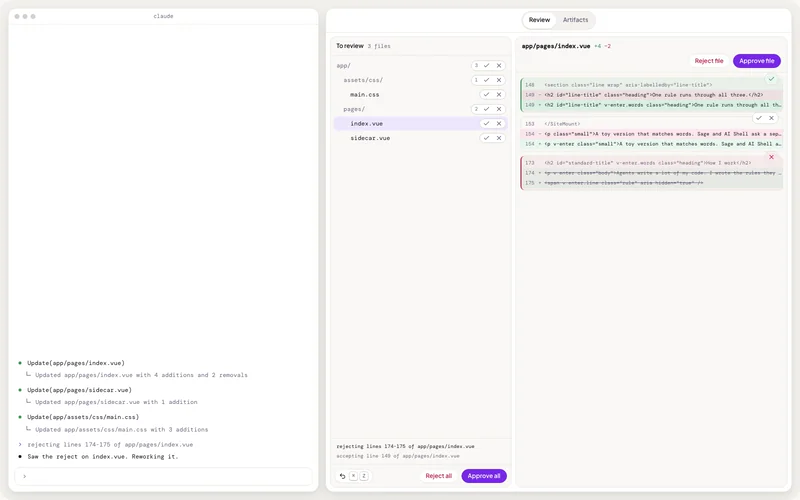
Sidecar sits next to Claude Code. You review what it changed, line by line, and when you comment on a page it built, the comment lands back in the conversation.
See Sidecar